Condition Assessment: How Much Detail is Needed and Where
Date:
Publication:
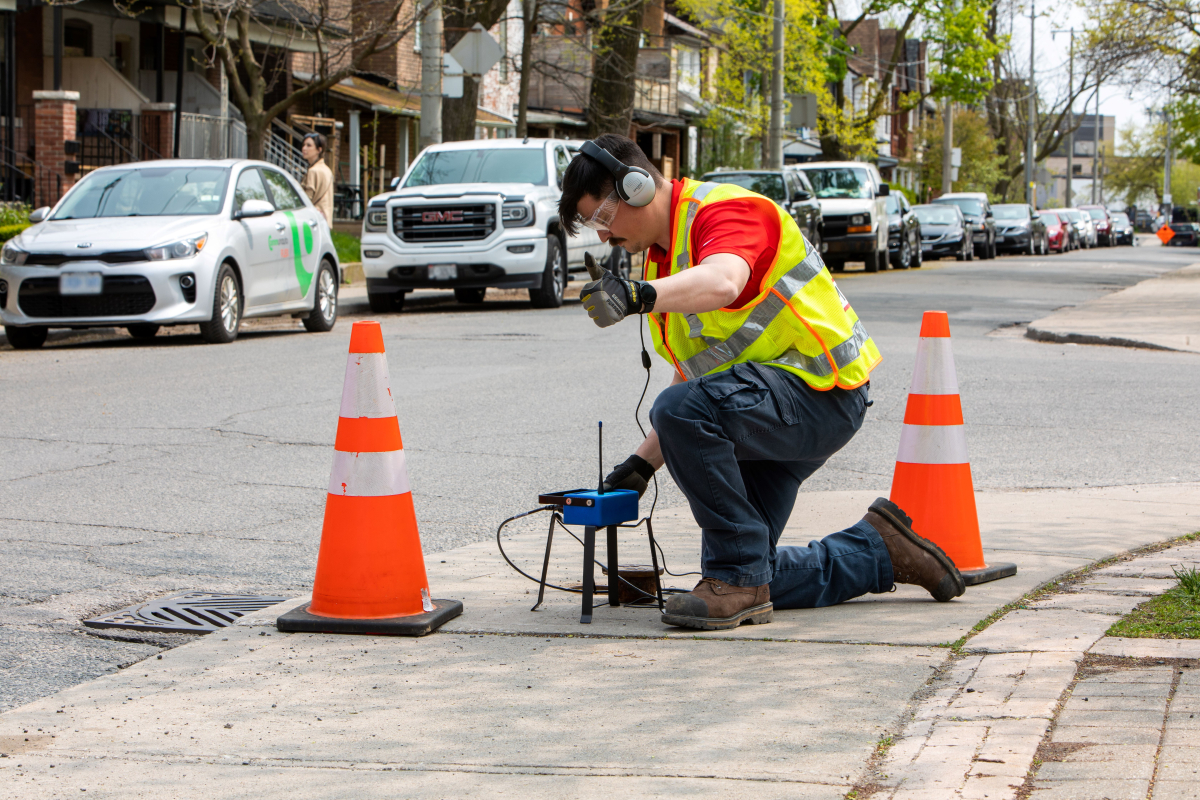
Some condition assessment services can support higher data resolution on specific pipe segments where more information may be required. Images courtesy of Mueller.
WATER DISTRIBUTION PIPELINES ARE UNDERGROUND, under pressure, and largely out of sight, which means deterioration is often undetected until a main breaks, or leaks surface, or water quality is compromised. Water utilities need to make the right capital investment for renewal decisions, and this requires defensible data which comes from a well developed condition assessment plan. A challenge with condition assessment planning is misalignment between the information a utility needs and the approach it pursues. Some utilities commit capital to only high-resolution technologies across distribution networks, even though a broader survey-level program would provide an adequate basis for replacement decisions. Others rely on desktop models alone to drive replacement priorities, forgoing the field validation to distinguish deteriorated mains from those with substantial service life remaining. In both cases, the outcome is the same: condition assessment expenditure that does not efficiently serve the decisions it is meant to inform. The issue is rarely a shortage of technology options. There is a wide range of condition assessment tools, including desktop modeling, non-invasive acoustic, pressure wave, electromagnetic, destructive sampling and more. The challenge lies in selecting the appropriate tool and data resolution for a given set of objectives and recognizing that greater detail is not always more valuable
The Condition Assessment Resolution Spectrum
Condition assessment methods span a wide range of resolutions. As resolution increases, so does cost, typically at the expense of network coverage. The value of the resolution directly relates to the decision it is meant to support. That balance looks very different for distribution mains versus transmission mains.
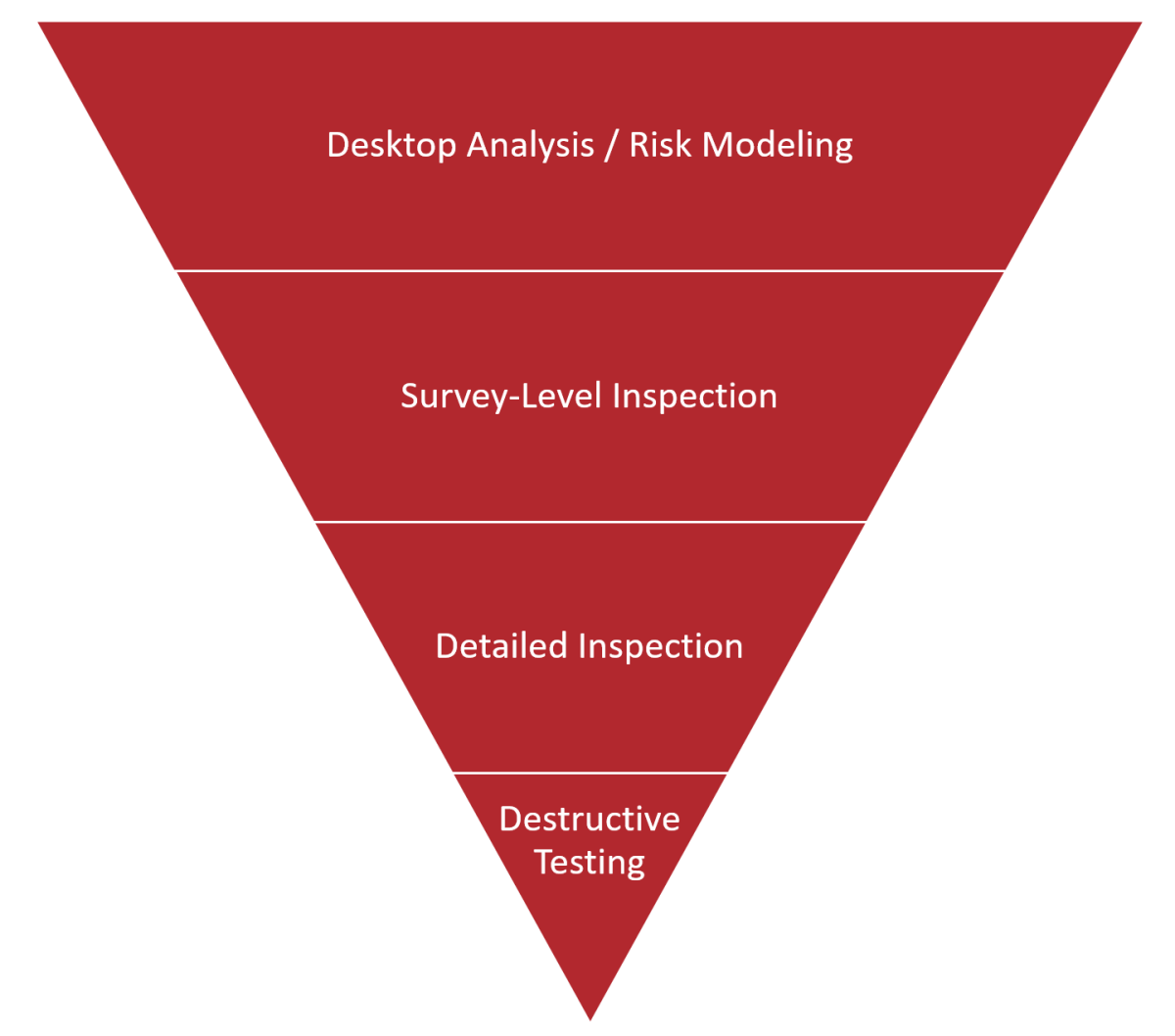
The inverted pyramid of condition assessment shows solution types from the least invasive to most invasive.
Distribution Systems: Where Coverage Matters Most
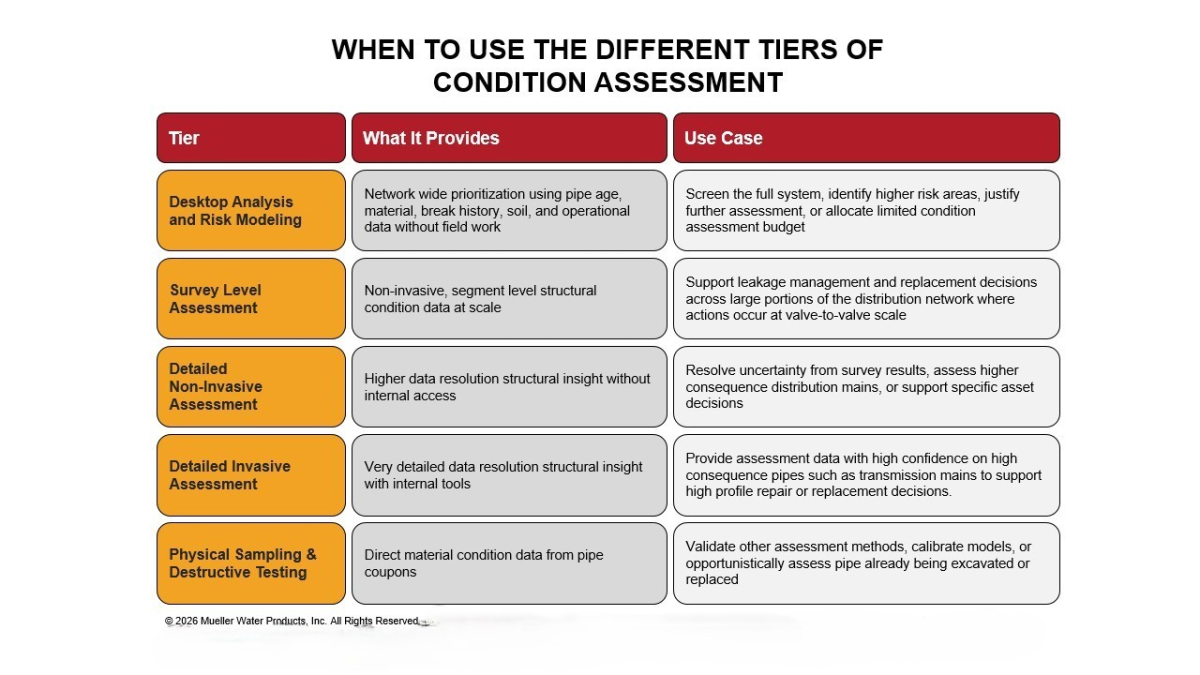
Distribution mains (i.e., 16 inches and under) make up roughly 90 percent of most utility networks. Because replacement decisions are made across lengths of pipe rather than spot defects, utilities benefit most from approaches that scale across large portions of the system. Four practical tiers are commonly applied: Desktop Analysis and Risk Modeling: Uses readily available data (age, material, break history, soil, operations) to prioritize where further assessment is needed. Best suited for system-wide screening and targeting limited assessment budgets. Survey-Level Assessment: Noninvasive tools provide sufficient structural insight to support leakage management and replacement decisions across large areas. This tier offers the best balance of coverage and resolution for most distribution networks. Detailed Non-Invasive Assessment: Higher-resolution data is applied selectively where consequences are higher or survey results are ambiguous, supporting specific asset-level decisions without full internal access. Physical Sampling and Destructive Testing: Used sparingly, typically to validate other methods or calibrate models when pipe is already exposed or being replaced.
Transmission Mains: Higher Consequences, Higher Resolution
Transmission mains carry higher risk and typically justify higher per-unit investment in condition assessment. While the progression from desktop screening to survey-level assessment is still recommended, transmission assets often warrant high-resolution internal or dewatered assessment where failure consequences and replacement costs are high.
Matching Resolution to the Decision at Hand
The right resolution for any condition assessment engagement depends on three things: the decision to be made, the consequences of getting it wrong, and the cost of extracting the information needed. Typically, it’s less granular for large area assessment, and high resolution for targeted areas that represent critical infrastructure or are already suspected to have an issue.
When Broad Coverage Beats Granular Detail
Distribution main replacement decisions are rarely made at the level of an individual pipe joint or a single 10- ft section. In practice, utilities replace lengths of main defined by access constraints, valve locations, street geometry, and contractor mobilization economics. Replacing a single short section of distribution pipe is seldom cost-effective once excavation, traffic management, and reinstatement are factored in; it’s more typical to replace the full run to the nearest endpoint. This operational reality has a direct bearing on the resolution required from condition assessment. If replacement will occur over longer lengths (i.e., 400- to 500-ft), then a point-by-point defect map may not change the decision, whereas assessing 2+ times more mains at survey resolution will be the same or lower cost for more practical data. If the question is whether a 400- or 500- ft main should be replaced or retained in service, structural integrity data at the same segment level (as provided by survey-level assessment) is generally sufficient. In most cases, the precise location of every corrosion anomaly or the residual wall thickness at specific points along the pipe adds cost without materially improving the decision to replace.
Further, average wall thickness measurements over the 400- to 500-ft length have been statistically shown to be significantly correlated to structural pipe defects such as longitudinal splits or circumferential breaks. For utilities managing risk across a large, aging network, the value of assessing a greater proportion of the system at survey resolution will typically outweigh the value of high-resolution data for a smaller subset of mains. AWWA Manual M77 supports this principle, recommending a staged approach in which broader assessment tools are used to prioritize areas warranting more detailed investigation.
When Higher Resolution is Worth the Investment
There are circumstances in which survey-level data is insufficient to support the decision at hand, and investing in higher-resolution inspection is justified:
Congested urban corridors: Where road excavation is extremely costly, for example, busy downtown streets, traffic management zones, or areas under excavation moratoriums, a utility may replace only a short length of pipe at a time. Knowing the exact condition of individual segments matters because the economics of replacement are driven by access and disruption cost rather than pipe length alone.
Major crossing assets: Pipes crossing railroads, highways, or major waterways often cannot be replaced without extraordinary permitting, coordination, and cost. Where there is concern that loading from above is accelerating deterioration (signs of microcracking, joint displacement, or accelerated corrosion), a higher resolution assessment provides the data needed to support a decision.
Pipes where spot repair is preferred over replacement: Where a utility is evaluating the opportunity to clean and/or spot repair sections of the pipe rather than replace the pipe length outright, a clear understanding of the pipe’s condition is necessary to determine where the repair is required and whether it can support it. Higher resolution assessment provides that confidence.
Targeted validation: Survey-level results sometimes flag a segment as moderate or ambiguous - neither clearly good nor failing. A targeted high-resolution follow-up on those specific sections resolves the uncertainty.
The unifying principle is that higher resolution data, whether non-invasive or invasive, is justified when the cost of the decision or the cost of getting it wrong is proportionally high.
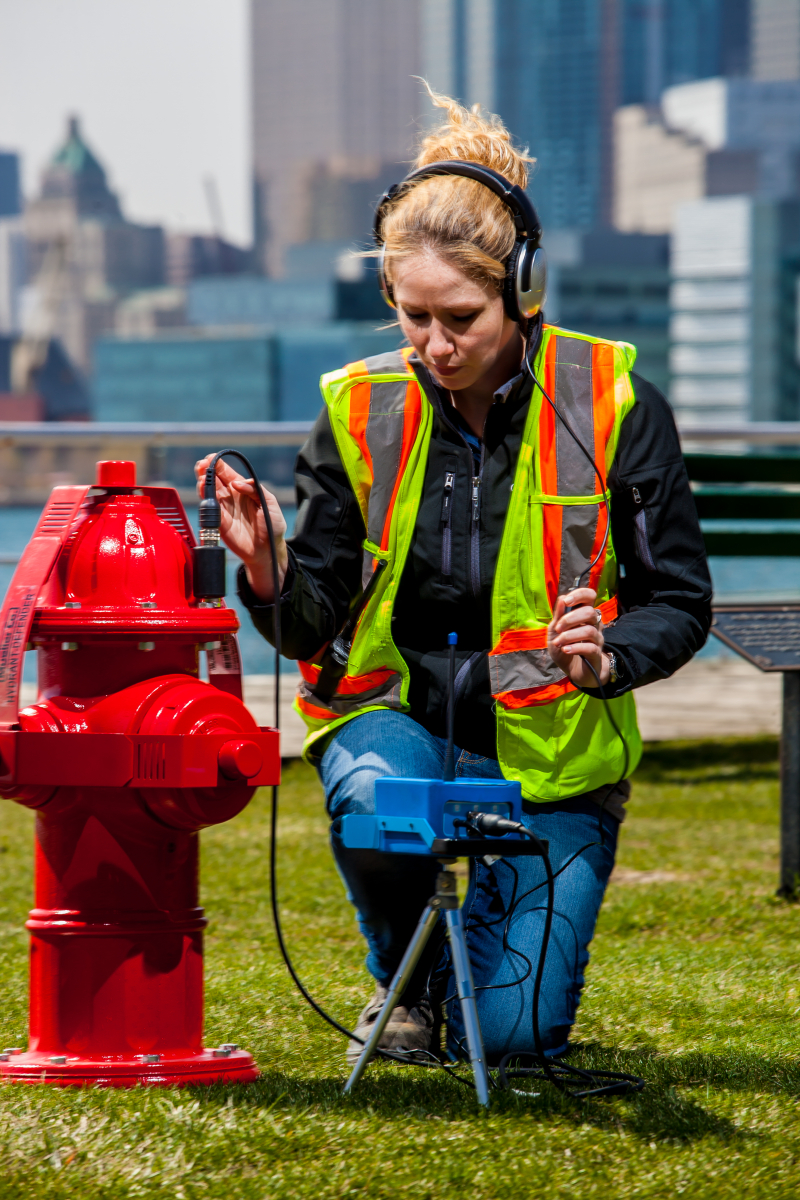
A successful condition assessment program delivers results that support practical, justifiable decisions.
Integrating Both
The most effective condition assessment programs do not choose between scale and detail, they use both. The goal is to build a program around outcomes, and to let the data needed inform the required resolution for different parts of the network or stages of the project.
Start with Objectives, Not Tools
The foundation of any effective program is a clear articulation of what the utility is trying to accomplish. The objectives may be reducing water loss, validating or deferring a planned replacement program, identifying the highest-priority segments within a capital budget, or building the data foundation for a long-term asset management plan. Each goal leads to a different program structure, and none is well served by a generic approach that applies the same level of assessment across the network. A utility managing a 200-mile aging distribution system on a limited budget starts with a desktop risk model which could be as simple as age or break based ranking of the network and identifying where condition data is required. The remaining budget is strategically allocated to a condition assessment approach that includes different levels of data resolution.
Integrating Scale and Detail
The Echologics® ePulse® condition assessment service is one example that illustrates how a purpose-built program can integrate both levels of condition assessment within a single, outcomefocused engagement. This service can be deployed at standard resolution or detailed resolution or both, assessing distribution mains from access points without flow disruption or excavation.Standard ePulse service supports large-scale network coverage efficiently, allowing utilities to move through substantial lengths of distribution mains within a single season of assessment. In parallel, detailed ePulse service can support higher data resolution on specific segments where more information is required. The result is a tiered program that allocates the more detailed, and consequently higher-cost assessment, to smaller areas that need it most, while maximizing network coverage with a standard assessment across the broader system to fit within a limited budget. This flexibility matters because real pipe networks do not present uniform risk.
Meaningful Results and Actionable Data
A successful condition assessment program delivers results that support practical, justifiable decisions. For distribution networks, that means results that can be translated into replacement, deferral, or rehabilitation decisions at the same scale utilities act on. Results need to support prioritization of replacement candidates, justification for deferral, and identification of where rehabilitation (e.g., lining) is feasible at a resolution that aligns with how these projects are typically scoped and executed. Data needs to include wall thickness, degradation relative to nominal thickness, a qualitative condition rating, and a remaining service life estimate based on current condition. The degradation metric gives utilities a quantitative way to compare segments and prioritize replacement. The condition rating provides a qualitative prioritization that can be communicated across engineering, operations, and leadership without losing the underlying technical meaning. The remaining service life estimate supports capital timing by distinguishing assets that should be advanced in the renewal program from those that can remain in service and be re-assessed in a future cycle. These deliverables, found in solutions like ePulse, also support decisions where replacement is not the default outcome. Where a utility is considering cleaning and structural lining, wall thickness and degradation become key inputs to determine whether rehabilitation is feasible and justifiable. Finally, results should not just sit in a report. Actionable data should improve decisions over time. Results should be fed back into a utility’s desktop risk model to calibrate assumptions, refine prioritization, and improve targeting in future cycles. The feedback loop matters because it improves targeting over time, so each assessment cycle helps ensure that the next capital dollar is spent more effectively than the last.
Author: Laura Sproule is product manager for Mueller Water Products.