Understanding Butterfly Valves in Data Center Cooling Applications
Date:
Publication:
Why it’s critical to use the proper industrial valves for this harsh environment for the safety of operations and equipment.
LARGE DATA CENTERS ARE DENSE, POWER-HUNGRY ENVIRONMENTS where GPU-laden racks can draw 50 kW or more per cabinet, resulting in heat loads that conventional air cooling simply cannot manage. The industry’s response has been a pivot to liquid-based hydronic systems: chilled water loops, condenser water circuits and cooling distribution units (CDUs) that circulate water/glycol mixtures at scale around the clock.
Within those loops, butterfly valves isolate chillers for maintenance, balancing flow across distributed cooling units and throttling to match thermal demand. The problem is that some engineers still reach for the same light-commercial butterfly valve when they should be using industrial standard valves.
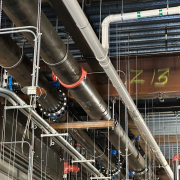
What glycol does to a valve
Most closed-loop data center cooling systems run on a water/glycol mixture, typically propylene or ethylene glycol blended to provide freeze protection and corrosion inhibition. The choice of glycol matters: propylene glycol is higher viscosity and preferred in applications with human exposure risk, while ethylene glycol offers better thermal performance in lower temperature applications.
What both formulations have in common is their effect on valve components over time. Glycol mixtures are chemically aggressive toward elastomers not explicitly formulated for the service. Seats made from standard rubber compounds may experience swelling, hardening or chemical creep that compromise shutoff. In a commercial HVAC butterfly valve, where the design life assumption is periodic use in a comfort cooling system, this is a manageable issue. In a data center cooling loop operating continuously at elevated pressure, seat degradation is a failure mode with serious consequences.
The most common failure point in butterfly valves exposed to long-term water/glycol service is seat deterioration. Combating this requires three disciplines working together: Specifying a seat elastomer, such as EPDM, that is chemically compatible with the specific glycol and concentration in service; Implementing a valve cycling schedule to prevent rubber setting in a single position over extended periods; and, Selecting a valve design that minimizes stress concentration on the seat when closed.
Why API 609 and API 598 set the right bar
The American Water Works Association (AWWA) standards govern water distribution service; Manufacturers Standardization Society (MSS) standards cover general industrial piping; and the American Petroleum Institute (API) standards were developed for the demanding, continuous-duty environments of refineries and petrochemical plants. This makes API the appropriate reference for modern data center cooling infrastructure.
API 609 establishes the design and performance requirements for butterfly valves in industrial service, addressing seat integrity, pressure ratings, end-connection dimensions, and actuation mounting. API 598 covers valve inspection and testing, with requirements that ensure a valve is drip-tight before it leaves the factory and before it is installed in a system.
For engineering firms and EPC contractors, specifying API 609/598-compliant valves simplifies the entire procurement process: fewer submittal exceptions, shorter review cycles and less engineering rework. A valve that arrives already tested to a recognized standard does not require the project team to verify performance assumptions.
A common question is, could an AWWA-rated valve be adapted to data center HVAC service with appropriate material upgrades? Technically, yes, but the economics are prohibitive. Specifying AWWA valves with the materials necessary to match an API-compliant valve’s performance would more than triple the valve cost.
Where butterfly valves do the work
In a modern data center hydronic system, butterfly valves appear at several critical junctures:
- Chiller and CDU isolation: Industrial butterfly valves allow operators to take individual chillers or cooling distribution units offline for maintenance without interrupting the broader cooling loop. This is essential in a facility that requires thermal continuity.
- Flow balancing: Large hydronic networks require precise flow distribution across multiple CRAC/CRAH units. Industrial butterfly valves provide the low-pressure-drop characteristics and good Cv values necessary for efficient pumping across extended pipe networks.
- Zone control: As data centers scale and add capacity, butterfly valves enable modular expansion of the hydronic system without wholesale reconfiguration.
Space is another variable that favors butterfly valves. Data centers are usually constrained environments that must accommodate increasingly dense equipment in fixed footprints. Industrial butterfly valves, in both lug and wafer body styles, require significantly less lay length than gate or globe valves.
Actuation integration is also important. Modern data centers rely on Building Management Systems (BMS) to monitor and control thermal conditions in real time. Butterfly valves with ISO 5211-compliant top flanges accommodate the full range of actuators (electric, pneumatic, gear-operated) and can be integrated into BMS platforms without requiring custom interface hardware.
Industrial performance in hydronic service
Industrial butterfly valves are built for high flow, low operating torque, and reliable sealing across both bidirectional and end-of-line applications. The seat design is central to the valve’s performance in glycol service. Valves in these applications must operate at higher pressure ratings, with full vacuum service capability, and allowances for the rubber to compress and flow into the body groove during cycling rather than setting under sustained load. Secondary shaft seals in some models prevent leakage from the shaft area, a failure mode that standard commercial valves often under address.
For engineers, the practical implications of these designs include lower flow resistance, higher Cv values that reduce system operating costs, and reduced operating torque that simplifies actuator sizing.
From a procurement standpoint, a single large data center project can deplete a manufacturer’s or distributor’s inventory of a particular valve size in a single order. Be sure to check with valve suppliers early so they can plan their inventory well in advance and ensure delivery meets construction deadlines.
Specifying right
It’s important to consider the total cost of ownership for industrial-grade butterfly valves in data center cooling systems. Some butterfly valve designs are not optimized for data center cooling applications and may require more frequent maintenance/seat replacements, along with the associated costs of draining a cooling loop, scheduling a maintenance window around active server racks and sourcing replacement parts. This will result in higher overall lifecycle costs.
Conversely, an industrial butterfly valve with appropriate glycol-compatible seat materials, factory-tested to API 598, with a design that accommodates the actuation platform already deployed in the facility, represents infrastructure that can be relied on for many years.
As data center construction continues its aggressive expansion, driven by AI compute demand, cloud infrastructure buildout and hyperscale deployments, the engineering community has an opportunity to set the specification baseline correctly.